.png)
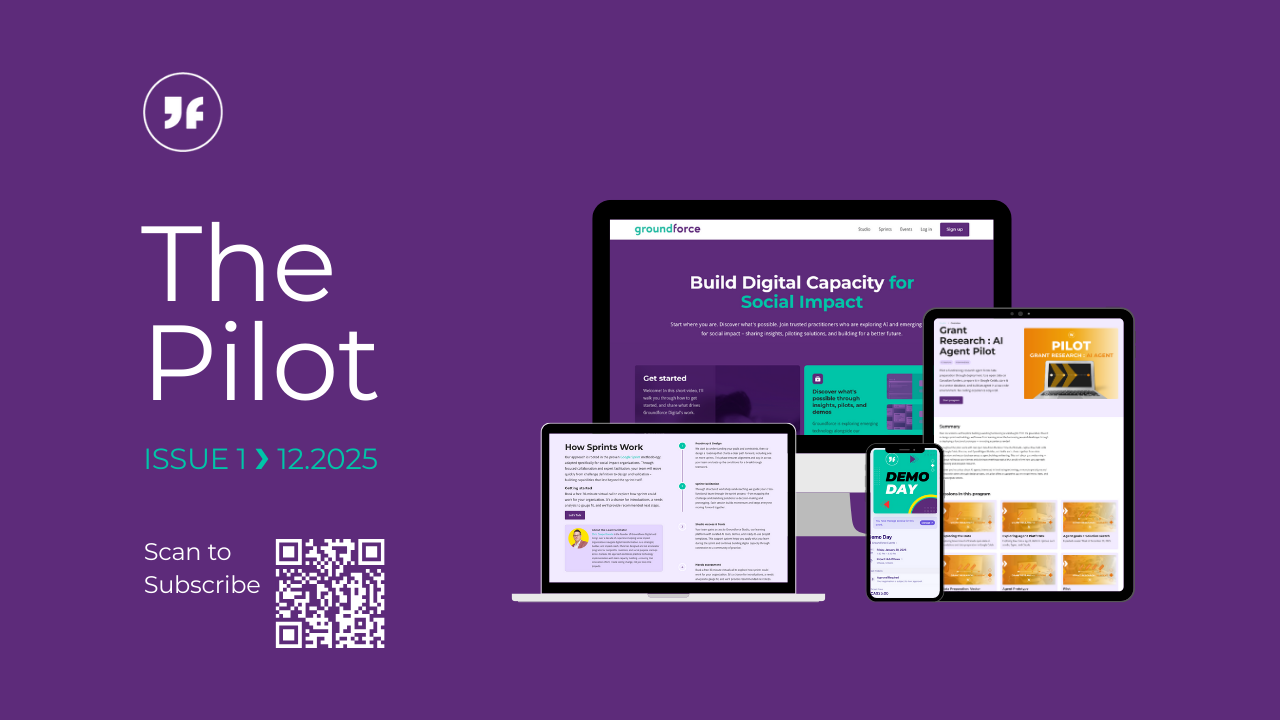
Since launching The Pilot newsletter in December, it has been great hearing from you. The conversations I've been having with executives across a wide range of social impact organizations are surfacing consistent themes — ones that are shaping this issue and those moving forward.Leaders are being squeezed from several directions. Boards are asking about AI governance and strategies. Staff are split between enthusiasm and resistance. And management is grappling with technology change in every aspect of the organization — all at once.
The data backs this up. 80% of Canadian non-profits are using AI, yet only 10% have formal governance policies—and fewer than 1% of the sector's workforce occupies technology roles. Non-profits are structurally under-resourced for the digital moment we’re in.

I've worked in technology consulting with social impact organizations for over a decade, and the traditional model has a fundamental limitation: short-term engagements that deliver a strategy and expect the client team to carry it forward. In a stable environment, that can work. But right now, AI technologies are evolving week to week, and what's available today may be overtaken tomorrow. Organizations don't just need a plan, they need the ongoing leadership capacity to adapt it.
Fractional Leadership – A Model Fit for Non-Profits
Fractional executive leadership is well established in the non-profit sector for functions like finance and human resources. Most organizations don't need — and can't afford — a full-time CFO, so they bring one in part-time. It's now worth considering a similar model for technology leadership.
A fractional Chief Technology Officer (CTO), Chief Information Officer (CIO) or equivalent addresses what consulting cannot: the need for someone at the C-suite level who is part of the core team — present not just to conceive of the strategy but to implement it, adapting along the way. The Bridgespan Group recommends investing in CTO and CIO leadership, including fractional models, as a way to improve strategic decision making, and navigate technology adoption organization-wide.
I'm putting this approach into practice at the Art Canada Institute (ACI). After serving in an advisory capacity since 2024, I recently became ACI's first Chief Technology Officer—in a fractional capacity. As an embedded member of the team, I'm developing digital strategy, evaluating vendors, setting data governance standards, and guiding the rollout of new tools from pilot to adoption. For ACI, that means consistent leadership within budget. For me, it means contributing more deeply to a cause I care about alongside an outstanding team.
Why Now
Being there through the process means strategy can evolve with the organization, starting where the team is at today, rather than waiting, or receiving a deliverable that’s either outdated or out of step with in-house capacity.
The technology isn't waiting. The gap between what AI can do today and what most organizations realize may be widening due to advances in the way that AI models are reshaping software development. A fractional technology leader could help your organization keep pace.
Leading a social impact organization through this moment? I'm always happy to connect — email me or book a needs assessment call.

.png)